Anatomy and Physiology Study Guide PDF: An Overview
Anatomy and Physiology study guides, often in PDF format, simplify complex topics. Resources like OpenStax and illustrated guides aid learning, focusing on structure-function relationships.
What is Anatomy and Physiology?
Anatomy, at its core, is the study of the body’s structures – a detailed exploration of its physical parts, from macroscopic organs down to microscopic cells. It’s about what things are and where they are located within the human form. Historically rooted in dissection, modern anatomy utilizes advanced imaging techniques to visualize internal structures non-invasively.
Physiology, conversely, delves into the functions of those structures. It investigates how the body parts work, both individually and in coordinated systems, to maintain life. This encompasses biochemical and physical processes, exploring everything from nerve impulses to muscle contractions and gas exchange.
Crucially, anatomy and physiology aren’t isolated disciplines; they are inextricably linked. Understanding the structure of a component is essential to comprehending its function, and vice versa. The Los Angeles Valley College Library highlights this relationship, emphasizing the study of structure in relation to function. A comprehensive study guide PDF will therefore integrate both aspects, providing a holistic understanding of the human body. Resources like those found at Hillsborough College offer interactive tools to reinforce these concepts.
The Importance of a Study Guide
Anatomy and Physiology presents a vast amount of information, making a dedicated study guide PDF invaluable. These guides distill complex concepts into manageable sections, aiding comprehension and retention. They often include labeled diagrams, clinical correlations, and review questions – elements crucial for success.
A well-structured guide, like those supplementing OpenStax textbooks, helps students move beyond rote memorization towards a deeper understanding of the material. They facilitate active learning by prompting self-assessment and identifying areas needing further review. Resources such as DOKUMEN.PUB offer illustrated guides designed to alleviate the perceived “scary” aspects of the subject.
Furthermore, study guides are essential for exam preparation. They help students organize their notes, prioritize key concepts, and practice applying their knowledge to clinical scenarios, as emphasized in Andreas Vesalius’s study guide. Utilizing lab guides alongside a comprehensive PDF ensures a complete grasp of both theoretical knowledge and practical application, ultimately improving performance.

Key Anatomical Terminology
Anatomy and Physiology relies on precise language. Study guides define terms like superior and inferior, alongside planes of the body, and locations within cavities.
Basic Anatomical Terms (Superior, Inferior, etc.)
Understanding foundational anatomical terms is crucial when utilizing an Anatomy and Physiology study guide PDF. These terms provide a standardized vocabulary for describing body structures and their relationships.
Superior and inferior denote position relative to a reference point; superior means towards the head, while inferior indicates towards the feet. Anterior (ventral) and posterior (dorsal) describe positions relative to the front and back of the body, respectively.
Medial and lateral refer to proximity to the midline; medial structures are closer to the midline, and lateral structures are further away. Proximal and distal are used for limbs, with proximal being closer to the point of attachment (e.g., shoulder or hip) and distal being further away.
Furthermore, terms like superficial (closer to the surface) and deep (further from the surface) are essential for describing tissue layers. A comprehensive study guide will thoroughly define and illustrate these terms, often with diagrams, to ensure a solid grasp of anatomical positioning. Mastering these terms is fundamental for interpreting anatomical descriptions and understanding physiological processes.
Planes of the Body (Sagittal, Coronal, Transverse)
A robust Anatomy and Physiology study guide PDF dedicates significant attention to the planes of the body, essential for visualizing anatomical structures and understanding sectional views. These imaginary flat surfaces divide the body for descriptive purposes.

The sagittal plane divides the body into left and right sections. A midsagittal plane creates equal halves, while parasagittal planes are offset from the midline. The coronal (frontal) plane separates the body into anterior and posterior portions. Imagine slicing the body like a loaf of bread from side to side.
Finally, the transverse (horizontal) plane divides the body into superior and inferior sections, creating a cross-section. This plane is useful for imaging techniques like CT scans and MRIs.
Understanding these planes is vital when interpreting anatomical images and describing the location of structures within the body. A quality study guide will include diagrams illustrating each plane and examples of structures visible in each section, reinforcing comprehension and spatial reasoning skills.
Body Cavities (Dorsal & Ventral)
A comprehensive Anatomy and Physiology study guide PDF thoroughly explains the body’s cavities, crucial for understanding organ placement and protection. These spaces enclose internal organs, providing a degree of cushioning and allowing for changes in shape. The two main categories are dorsal and ventral.
The dorsal body cavity includes the cranial cavity, housing the brain, and the vertebral cavity, encasing the spinal cord. These are both protective bony structures. The larger ventral body cavity is further subdivided.

The superior thoracic cavity contains the heart and lungs, while the inferior abdominopelvic cavity houses the abdominal organs (stomach, intestines, liver) and pelvic organs (bladder, reproductive organs).
A good study guide will detail the membranes lining these cavities (serous membranes) and the organs within. Diagrams illustrating the location of each cavity and its contents are essential for visualization. Understanding these spatial relationships is fundamental to grasping physiological processes and clinical applications.
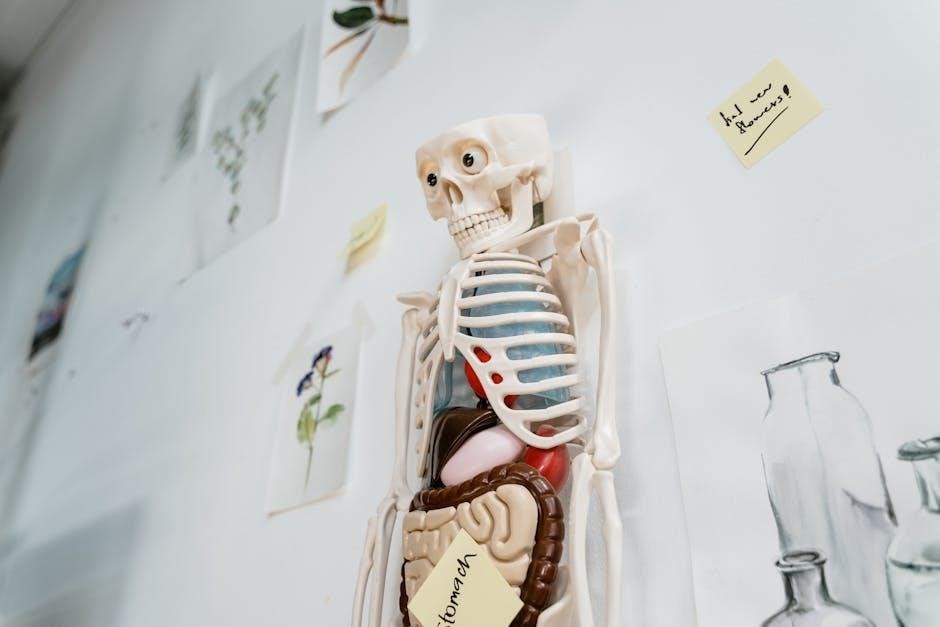
Body Systems: A Comprehensive Look
Anatomy and Physiology study guide PDFs detail integrated body systems – skeletal, muscular, nervous, cardiovascular, and respiratory. Understanding their structures and functions is vital for holistic comprehension.
Skeletal System – Structure and Function
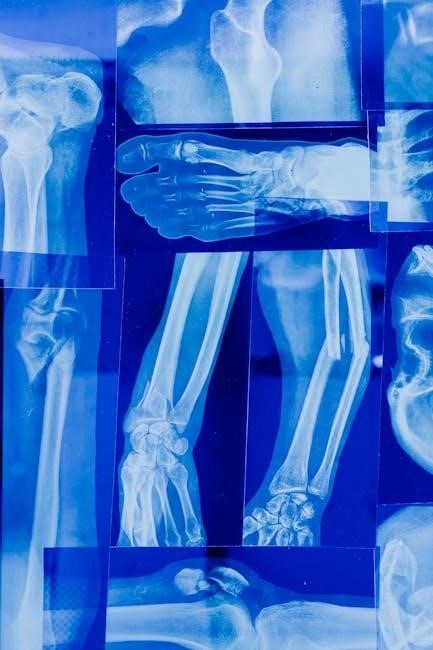
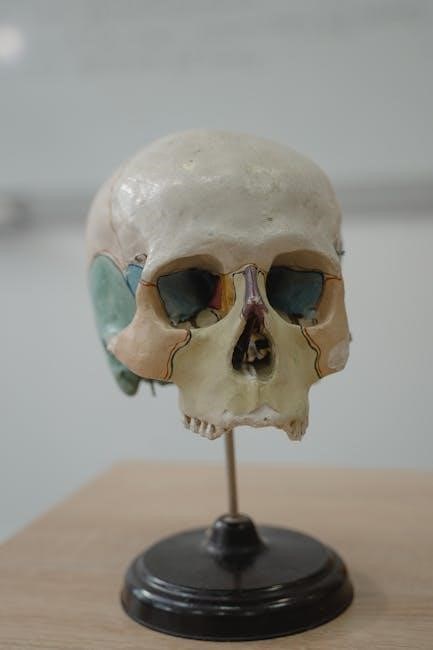
Anatomy and Physiology study guide PDFs dedicate significant sections to the skeletal system, detailing its crucial roles. These guides explore bone composition – including compact and spongy bone – and classifications based on shape: long, short, flat, irregular, and sesamoid. They illustrate bone structures like epiphyses, diaphyses, and articular cartilage.
Functionally, these resources emphasize support, protection of vital organs (like the skull safeguarding the brain), assistance in movement via muscle attachment, mineral storage (calcium and phosphate), and blood cell formation (hematopoiesis) within bone marrow.
PDF guides often include detailed diagrams of specific bones – femur, humerus, vertebrae – and joints – synovial, cartilaginous, fibrous – explaining their range of motion and stability. Clinical correlations, such as fractures, osteoporosis, and arthritis, are frequently included to demonstrate the practical application of anatomical knowledge. Understanding skeletal anatomy is foundational for grasping overall body mechanics and potential pathologies, making it a core component of any comprehensive Anatomy and Physiology study resource.
Muscular System – Types and Mechanics
Anatomy and Physiology study guide PDFs thoroughly cover the muscular system, categorizing muscle tissues into skeletal, smooth, and cardiac types. Skeletal muscle, responsible for voluntary movement, receives detailed attention, including its hierarchical structure – fascicles, muscle fibers, myofibrils, and sarcomeres. Guides illustrate the sliding filament theory, explaining how actin and myosin interact to produce contraction.
Smooth muscle, found in internal organs, and cardiac muscle, exclusive to the heart, are also explained, highlighting their involuntary nature and unique structural features.
These resources detail muscle mechanics: concepts like leverage, contraction types (isotonic and isometric), and the roles of agonists, antagonists, and synergists. Neuromuscular junctions and the role of neurotransmitters in initiating contraction are also frequently covered. Clinical connections, such as muscle strains, cramps, and muscular dystrophies, are often included. A strong understanding of muscle structure and function, as presented in these Anatomy and Physiology guides, is vital for comprehending movement and physiological processes.
Nervous System – Central & Peripheral Divisions
Anatomy and Physiology study guide PDFs dedicate significant sections to the nervous system, meticulously detailing its two primary divisions: the central nervous system (CNS) and the peripheral nervous system (PNS). The CNS, comprised of the brain and spinal cord, is explored through detailed diagrams and explanations of its structural components – cerebral cortex, cerebellum, brainstem, and associated pathways.
Guides clarify the functions of different brain regions and the protective mechanisms like the meninges and cerebrospinal fluid. The PNS, encompassing cranial and spinal nerves, is examined in relation to sensory and motor functions.
These resources explain the cellular basis of neural communication, focusing on neurons, glial cells, and synaptic transmission. Action potentials, neurotransmitters, and receptor types are thoroughly covered. Clinical correlations, such as stroke, spinal cord injuries, and neurological disorders, are frequently integrated. A comprehensive Anatomy and Physiology understanding, facilitated by these guides, is crucial for grasping how the body receives, processes, and responds to stimuli.
Cardiovascular System – Heart, Blood Vessels, and Circulation
Anatomy and Physiology study guide PDFs extensively cover the cardiovascular system, beginning with detailed illustrations of the heart’s anatomy – chambers, valves, and major blood vessels. These guides break down the cardiac cycle, explaining systole, diastole, and the conduction system (SA node, AV node, Purkinje fibers) responsible for coordinating heartbeats.
Blood vessel structure – arteries, veins, and capillaries – is meticulously described, highlighting the differences in their walls and functions. Systemic and pulmonary circulation pathways are clearly mapped, emphasizing blood flow dynamics and pressure gradients.
Guides delve into blood composition, including erythrocytes, leukocytes, and platelets, and their roles in oxygen transport, immunity, and clotting. Clinical correlations, such as hypertension, atherosclerosis, and heart failure, are often included. Understanding these concepts, aided by Anatomy and Physiology resources, is vital for comprehending how the body delivers oxygen and nutrients while removing waste products.
Respiratory System – Gas Exchange and Ventilation
Anatomy and Physiology study guide PDFs dedicate significant sections to the respiratory system, starting with a detailed exploration of the upper and lower respiratory tracts. These guides illustrate the nasal cavity, pharynx, larynx, trachea, bronchi, and ultimately, the alveoli – the sites of gas exchange.

Ventilation mechanics – inspiration and expiration – are explained, focusing on the roles of the diaphragm and intercostal muscles. Guides clarify how pressure gradients drive airflow and detail lung volumes and capacities (tidal volume, vital capacity, etc.).
Gas exchange principles, including the partial pressures of oxygen and carbon dioxide, and the process of diffusion across the alveolar-capillary membrane, are thoroughly covered. Clinical connections, like asthma, pneumonia, and chronic obstructive pulmonary disease (COPD), are frequently integrated. Anatomy and Physiology resources emphasize how efficient gas exchange is crucial for cellular respiration and overall bodily function.
Resources for Anatomy and Physiology Study
Anatomy and Physiology study guide PDFs, Open Educational Resources (OER) like OpenStax, and lab manuals are invaluable. Online tutorials and supplemental materials enhance comprehension.
Open Educational Resources (OER) – OpenStax
OpenStax offers a freely accessible, high-quality Anatomy and Physiology textbook, a cornerstone for many students. This resource is particularly valuable as a foundation for creating a comprehensive study guide PDF. The textbook covers the human body’s structure and function with detailed illustrations and clear explanations, making complex concepts more approachable.
Furthermore, OpenStax provides accompanying resources, including instructor materials and student practice questions, which can be integrated into personalized study guides. Solutions manuals are also available, aiding in self-assessment and understanding. Los Angeles Valley College Library highlights OpenStax as a key OER for Anatomy and Physiology courses, emphasizing its focus on the relationship between structure and function.
Utilizing OpenStax as the core of a study guide PDF allows students to benefit from a rigorously reviewed and constantly updated resource, eliminating the financial barrier often associated with traditional textbooks. It’s a powerful tool for independent learning and exam preparation, fostering a deeper understanding of the subject matter. The textbook is designed for two-part courses, providing a complete overview of the field.
Utilizing Lab Guides and Manuals
Lab guides and manuals are indispensable components when constructing an effective Anatomy and Physiology study guide PDF. These resources bridge the gap between theoretical knowledge and practical application, offering hands-on experience with anatomical structures and physiological processes. Georgia State University utilizes a specific lab guide published by bluedoor, LLC, for their BIOL 2110K and BIOL 2120K courses, demonstrating their importance in curriculum.
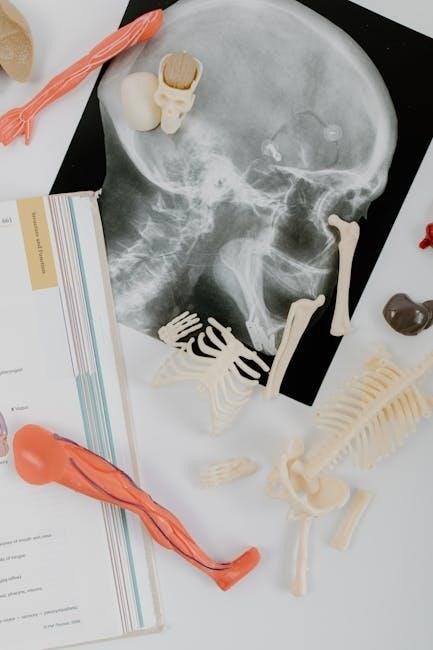
Integrating lab exercises, diagrams, and dissection notes into your PDF study guide reinforces learning and improves retention. Focus on clinical correlations, as highlighted in Andreas Vesalius’s study guide, to understand the practical relevance of anatomical knowledge. Detailed drawings and clinical terms are crucial for exam success.
A well-structured lab-focused study guide should include pre-lab questions, observation tables, and post-lab analysis sections. This approach encourages active learning and critical thinking. Supplementing textbook material with practical lab experiences creates a more holistic and effective learning tool, ultimately enhancing comprehension and performance in Anatomy and Physiology.

PDF Study Guides and Online Tutorials
Creating a comprehensive Anatomy and Physiology study guide PDF benefits greatly from incorporating readily available online tutorials. Numerous resources offer interactive learning experiences, complementing traditional textbook study. A free, interactive web-based tutorial provides images, tutorials, and quizzes, offering a dynamic learning environment. These digital tools often present complex concepts in a more accessible format.
When compiling your PDF, consider including links to relevant online resources, such as Open Educational Resources (OER) like those available through Los Angeles Valley College Library. These OER often cover gross and microscopic anatomy, emphasizing the structure-function relationship.
Furthermore, solutions manuals, like those for OpenStax College’s Anatomy & Physiology (ISBN: 9781711494067), available in PDF and DOCX formats, can aid in understanding challenging concepts. A well-curated study guide should blend the convenience of PDF format with the interactivity of online tutorials, maximizing learning potential and providing a robust study tool.